
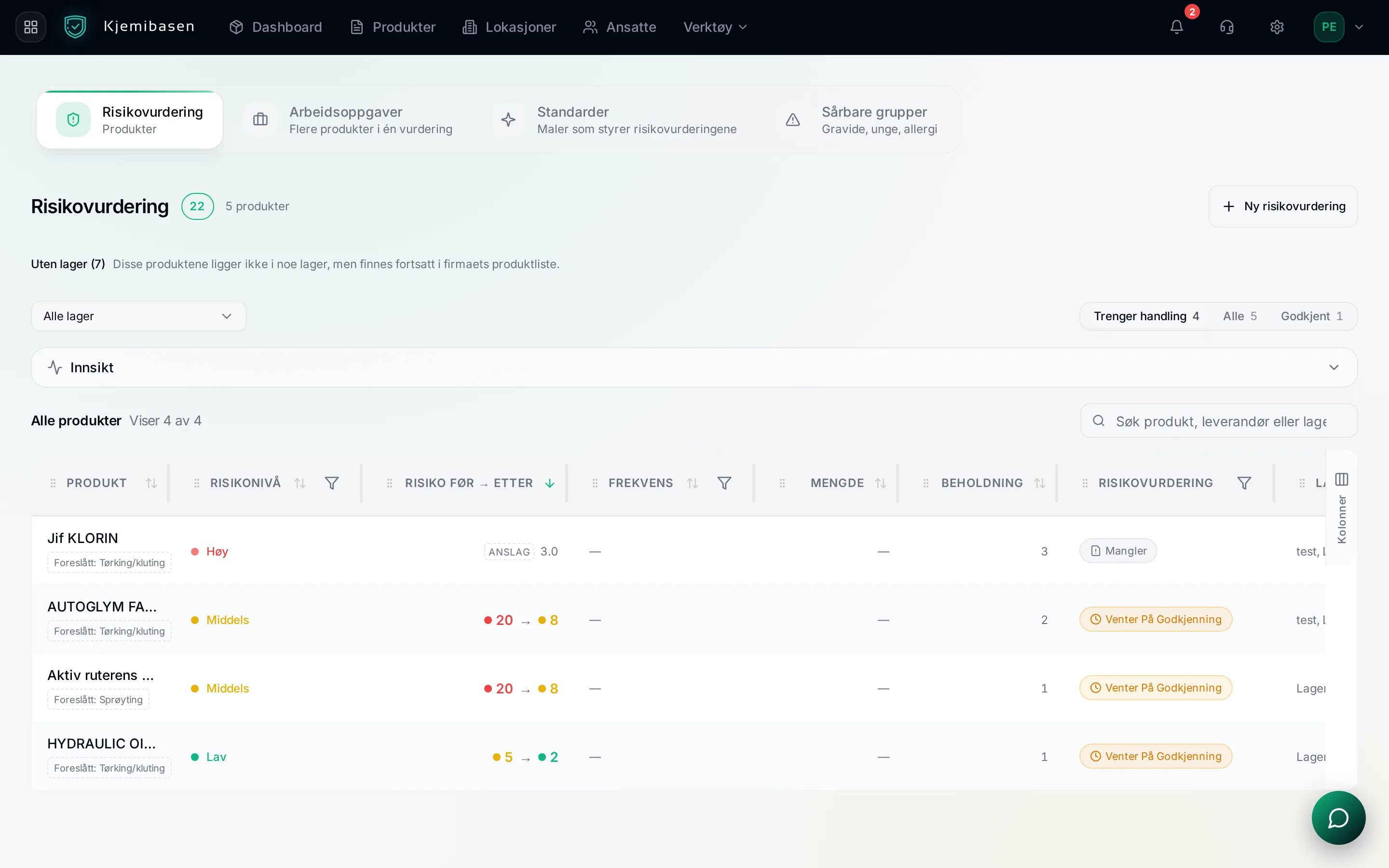
Chemical risk assessments are one of the most frequent areas for inspection findings. Not because companies disregard safety, but because manual paperwork across hundreds of products and tasks is time-consuming.
Here is the regulatory basis, a proven assessment methodology, a practical example, and an overview of how to automate the process.
What is a chemical risk assessment?
A chemical risk assessment is a documented evaluation of how likely a chemical is to cause harm, and how severe that harm could be in your specific workplace. It brings together two elements:
- Hazard – the intrinsic danger of the product, detailed in the Safety Data Sheet (Sections 2, 8, and 11).
- Exposure – how your team handles it in practice (frequency, duration, volume, and ventilation).
Hazard alone does not equal risk. A corrosive substance sealed in an automated piping system presents low exposure risk. A mild solvent sprayed daily in a confined space without extraction creates high risk.
Regulatory obligations
- Employers must ensure workplace safety when hazardous substances are handled.
- Health and safety regulations mandate identifying chemical hazards, assessing health risks, and recording findings in writing.
- Internal control regulations require regular hazard audits and verified corrective actions.
- An accurate chemical register with up-to-date SDSs forms the foundation of every risk assessment. See our guide on EHS requirements for chemical registers.
Step-by-step risk assessment process
Step 1: Inventory your products
List every chemical used, linked to specific work areas and storage cabinets. An incomplete inventory leads to incomplete safety assessments.
Step 2: Extract hazard data from the SDS
Review hazard statements (H-phrases), signal words, and GHS pictograms. Watch out for Carcinogenic, Mutagenic, or Reprotoxic substances (CMRs), sensitisers, and volatile organic compounds. Need a refresher on pictograms? Read our hazard symbols guide.
Step 3: Assess workplace exposure
Who handles the substance? For how long and how often? Is application done via brush, wipe, or spray? Are local exhaust ventilation systems present?
Step 4: Calculate risk rating
Combine severity (intrinsic hazard) with likelihood (exposure conditions) using a risk matrix.
Step 5: Implement controls using the hierarchy of controls
Elimination – can the task be performed without the chemical?
Substitution – is a less hazardous product available?
Engineering controls – local exhaust ventilation, closed transfer systems.
Administrative controls – safe operating procedures, shift rotations, training.
Personal Protective Equipment (PPE) – gloves, respirators, eye protection as the final line of defence.
Step 6: Document findings
Record the substance, exposure conditions, risk level, required controls, responsible manager, and re-evaluation schedule.
Step 7: Continuous review
Update documentation whenever an SDS revision arrives, product formulas change, or processes are updated.
Chemical risk matrix example
| Likelihood / Severity | Low | Medium | High |
|---|---|---|---|
| Low | Low | Low | Medium |
| Medium | Low | Medium | High |
| High | Medium | High | High |
Example: Workshop parts degreasing
- Hazard: Flammable liquid, H336 (may cause drowsiness), H315 (skin irritation).
- Exposure: Daily spray application, 20 minutes duration, open workbench without extraction.
- Initial Risk: Medium–High.
- Corrective Controls: Switch to an aqueous degreaser, install localized extraction arm, mandate chemical-resistant nitrile gloves.
- Re-evaluation Date: Following product trial, at latest within 12 months.
Why manual risk assessments fail during audits
- They are completed once and never maintained.
- Products change, but files reference discontinued formulas.
- Assessments lack clear connections to physical storage locations.
- Documents are buried in isolated spreadsheets inaccessible to floor workers.
Automated risk assessments in SDSLibrary
SDSLibrary handles the administrative workload:
- Hazard data is parsed automatically. Classifications, H-statements, and pictograms are extracted directly from the SDS.
- Baseline risk scores are calculated. High-risk chemicals are highlighted immediately.
- Automatic updates. When a revised SDS is uploaded, hazard data updates across linked assessments.
- Location mapping. Assessments stay connected to specific rooms and storage racks.
- Substitution candidates flagged. Products containing CMRs or severe hazards are tagged for chemical substitution review.
- Audit-ready exports. Generate consolidated PDF reports on demand.
Your team only enters site-specific details: how, where, and how often the chemical is handled.
Summary
Chemical risk assessments are a universal legal requirement. The logic is straightforward: hazard plus exposure equals risk. The challenge lies in scaling this across hundreds of substances and keeping it current. Automating data extraction with SDSLibrary solves the manual burden.
Frequently asked questions
Is a chemical risk assessment legally required?
Yes. Workplace health and safety frameworks require employers to evaluate hazardous chemicals, determine exposure risks to employees, and document controls in writing.
How often should chemical risk assessments be reviewed?
Whenever workplace conditions change: introducing a new product, receiving a revised SDS, altering work processes, or reporting health symptoms. A general review should also take place at least once a year.
What is the difference between an SDS and a risk assessment?
An SDS describes the intrinsic hazards of a product. A risk assessment evaluates how that product is actually handled in your workplace—who uses it, how frequently, in what quantities, and under what protective measures.
Can chemical risk assessments be automated?
Yes, to a significant extent. SDSLibrary extracts hazard statements, pictograms, and classifications from the SDS to calculate a baseline hazard level. You confirm local operational conditions, and the assessment is documented and audit-ready.
Who should participate in the risk assessment process?
Management holds responsibility, but safety representatives and workers who handle the chemicals should be directly involved. Occupational health specialists can advise on high-risk substances.
What should a chemical risk assessment template include?
A compliant template captures the product name, hazard classification from the SDS, exposure details, calculated risk score, control measures, responsible person, and next review date. SDSLibrary builds this into your digital register automatically.